
The Simplest Guide to Project Management
Begin your project management journey: A simple Project Management course designed to build a strong foundation in project planning, execution, monitoring, and delivery. Learn essential project management principles, tools, and best practices to successfully manage projects.
More about this course
Why you should take this course
Build a rock-solid foundation in project management by learning essential principles, tools, and techniques used to plan, execute, and deliver projects successfully across industries
Master core project management concepts and terminology—from project charters, WBS, critical path, and baselines to risk registers, earned value, and stakeholder management—so you can confidently speak the language of project management
Develop practical planning and execution skills including time, cost, scope, and resource management to keep projects on schedule, within budget, and aligned with business goals
Learn how to identify, assess, and manage risks effectively, using proven techniques such as risk breakdown structures, contingency planning, and change control to handle real-world project challenges
Prepare yourself for career growth and PMP®-aligned learning, making this course ideal for beginners, career changers, and professionals seeking a strong entry point into formal project management practices.
This course includes...

4.9 Ratings
Over 5,000 students world-wide have taken this course

2 + hours on-demand video
Starting with the fundamentals, the lectures cover the full extent of SAS programming concepts

6 Quizzes
Sharpen your skills with our extensive practice resources ! You will have ample resources to practice and learn.

1 Resource Guide
Practice with supporting resource guide

Lifetime Access
All the course content is yours to keep for life. That means there is no need to rush through the course.

Course Completion Certificate
Receive a course completion certificate that you can post on your social media.
What our students worldwide are saying about this course







More about the course
Course Overview
Embark on your journey to becoming a skilled project manager with our beginner course. Designed for those new to the world of project management, this course provides a solid foundation in the essential principles, tools, and techniques required to successfully plan, execute, and complete projects.
You'll explore the key concepts of project management, from defining project goals and objectives to understanding the roles and responsibilities of team members. Time and resource management are essential skills that you'll acquire during the course, ensuring that you can efficiently allocate resources, set realistic timelines, and keep your projects on track. Additionally, you'll gain insights into risk assessment and mitigation, helping you identify potential obstacles and devise strategies to navigate them effectively.
By the end of this program, you'll be equipped with the knowledge and skills necessary to confidently tackle projects of various sizes and complexities. You'll have a strong foundation in project management, enabling you to adapt and thrive in the ever-evolving landscape of business and technology.
Whether you're a recent graduate, a career changer, or simply someone looking to enhance their organizational skills, this course will empower you to confidently tackle projects of all sizes and complexities. Join us and kickstart your project management journey today!
Glossary of Key Terms taught in this course
Agile Approach: A project management approach that focuses on flexibility, collaboration, and iterative development, responding to change rather than rigidly following a predefined plan.
Baseline: A fixed reference point, in time, against which project performance can be measured. The three main types are scope, cost, and schedule baselines.
Budget at Completion (BAC): The total approved budget for the project, including all costs, contingency reserves, and management reserves.
Business Case: A document that justifies the need for a project by explaining its benefits, costs, and alignment with organizational strategy.
Change Control: A process of identifying, documenting, and managing changes to the project scope, schedule, or budget, aiming to reduce the impact of negative changes.
Contingency Reserve: Funds set aside to cover costs associated with planned responses to identified risks.
Control Account: A management control point where scope, budget, and schedule are integrated and compared with the actual performance.
Crashing: A schedule compression technique to reduce project duration by adding resources to critical path activities, which increases risk and costs.
Critical Path: The longest sequence of activities in a project that determines the shortest time needed to complete the project.
Decomposition: The technique of breaking down a project's scope into smaller, manageable components for ease of planning and execution.
Deliverable: Any unique and verifiable product, result, or capability produced to complete a process, phase, or project.
Earned Value (EV): The measure of value for the completed work at a given point in time, as compared to the planned budget for that work.
Enterprise Environmental Factors (EEF): Conditions, not under the control of the project team, that influence the project, such as regulations, market conditions, or political climate.
Fast Tracking: A schedule compression technique that involves doing activities in parallel that are usually done sequentially, which increases risk.
Gold Plating: Adding features or functionality that exceed the project’s requirements and do not add significant value.
Lessons Learned: Documentation of insights and experiences from a project that can be used to improve future projects.
Management Reserve: Funds set aside to cover unplanned changes or unforeseen events that were not identified during risk identification and planning.
Matrix Environment: An organizational structure that combines functional and projectized organizations, often sharing authority between functional and project managers.
Organizational Process Assets (OPA): An organization's internal policies, procedures, guidelines, templates, systems, and best practices that can be used to manage a project.
Plan Value (PV): The cost of work that has been authorized and budgeted for a scheduled activity or WBS component in a given time frame.
Portfolio: A collection of programs, projects, and operations managed as a group to achieve strategic objectives.
Program: A group of related projects, subprograms, and program activities managed in a coordinated way to achieve strategic benefits.
Project: A temporary endeavor to create a unique product, service, or result with a defined start and end.
Project Charter: A formal document that authorizes a project, establishes the project manager's authority, and outlines high-level requirements.
Project Constraint: Any limitation that restricts the actions of the project manager and team, such as time, budget, or scope.
Project Management: The application of knowledge, skills, tools, and techniques to project activities to meet project requirements.
Project Management Plan: A comprehensive document that integrates all individual management plans and provides guidelines for the project's execution, monitoring, and control.
Project Schedule: A document that establishes the start and end dates for project activities and milestones, and the sequence for the various steps.
Quality: The measure of to what extent you are satisfying the customer by meeting their requirements on the project.
Requirements Traceability Matrix: A document that links requirements to their origin and tracks them throughout the project lifecycle.
Risk: An uncertain event that, if it occurs, can have a positive or negative effect on project objectives.
Risk Breakdown Structure (RBS): A hierarchical structure for categorizing and managing project risks.
Risk Register: A document containing information about identified risks, their analysis, and response strategies.
Scope: The work that must be done to deliver the project, or product or service.
Scope Baseline: A group of documents that collectively describe the project scope.
Scope Creep: Changes to the project scope that are not approved by the project stakeholders or included in the project baseline.
Schedule Performance Index (SPI): The ratio of the earned value to the planned value, indicating whether the project is on, behind, or ahead of schedule.
Scheduled Variance (SV): The difference between the earned value and planned value that indicates by how much the team has lagged behind in delivering the expected project value.
Stakeholder: Any individual, group, or organization that can affect, be affected by, or perceive itself to be affected by a project.
Stakeholder Register: A document that identifies key project stakeholders and includes information about their roles, influence, and expectations.
System of Value Delivery: A mechanism by which organizations formulate, move, and deliver value from concept to cash through portfolios, programs, projects, and operations.
Work Breakdown Structure (WBS): A deliverable-oriented hierarchical decomposition of the project work into manageable components and visualizes the full scope of the project.
Work Package: The smallest unit of work in the WBS that can be accurately estimated for resources, cost, and time.
Download the free Resource Guide for PMP Exam as accompanying slides and notes. Use it for quick reference to the lectures, make your own notes on top of this, or use them as presentation slides wherever you want !
Course Highlights
what we have achieved through this course
110k +
minutes taught
5k+
students taught
147+
countries where our students come from
Still unclear on any topics? See our FAQs to get answers to most common questions
Frequently asked questions
Everything you need to know about the course
No, you can enroll in this course even if you don't have prior
project management experience. The course is designed for absolute beginners in project management.
Yes, our course content is updated regularly to align with
the latest PMBOK@ Guide and the current PMP exam
content outline. You can rest assured that you will be
learning relevant and up-to-date information.
The course includes practical examples and real-
world scenarios to help you apply project management
concepts in various situations. This hands-on approach will
enhance your understanding and ability to manage projects
effectively.
Yes, you will have the opportunity to interact with instructors
through live Q&A sessions and participate in discussions
with fellow learners. This collaborative learning environment
will help clarify doubts and enrich your learning experience.
Yes, the course includes practice tests and mock exams that
simulate the actual PMP Certification Exam. These
assessments will gauge your readiness and provide valuable
feedback to fine-tune your exam preparation.
You get lifetime access to the course, including:
All current lessons
Future updates
Any newly added content at no extra cost
Once you enroll:
You’ll receive instant access via your account
Courses can be accessed on desktop, tablet, or mobile
All videos are available for streaming anytime
For content protection:
Videos are streaming only
You can rewatch them as many times as you want online
Yes.
After completing the course, you will receive a certificate of completion, which you can:
Add to your resume
Share on LinkedIn
Use for professional development records
Get Your Course Completion Certificate
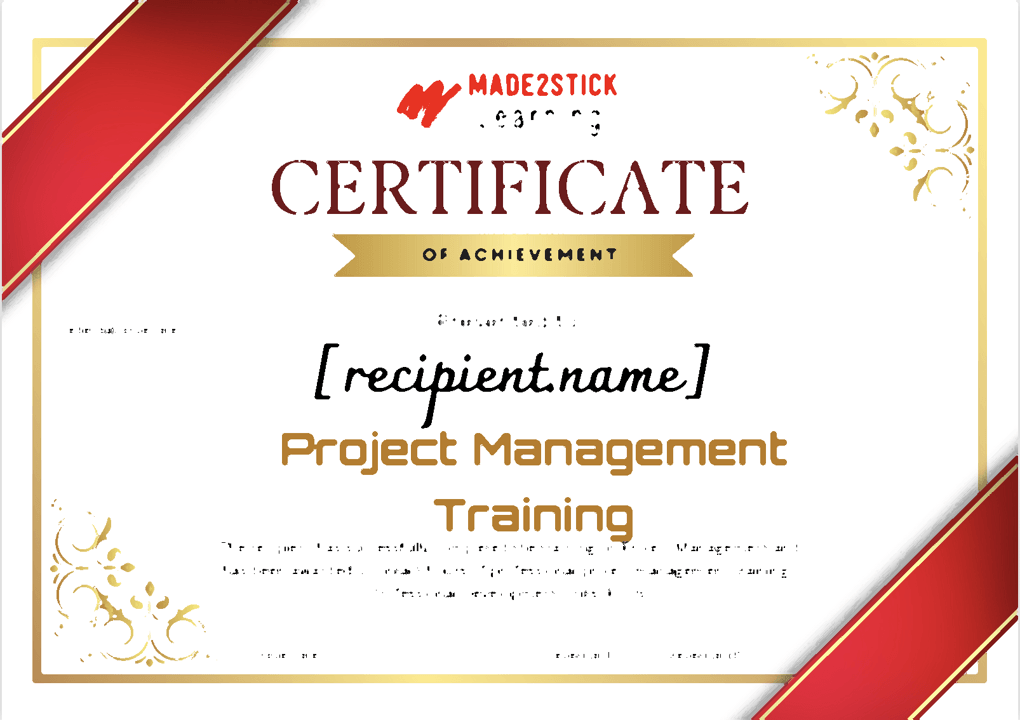
Order your course completion certificate after successfully finishing the entire training program. To be eligible, you must have viewed all lectures, completed all quizzes and assignments, and attempted the practice exams at the end of the course.
A small $1 processing fee is applied to cover administrative and system handling costs associated with issuing the certificate. Please allow up to 24 hours for your certificate request to be processed.