
Risk Management is not paperwork - It's Leadership
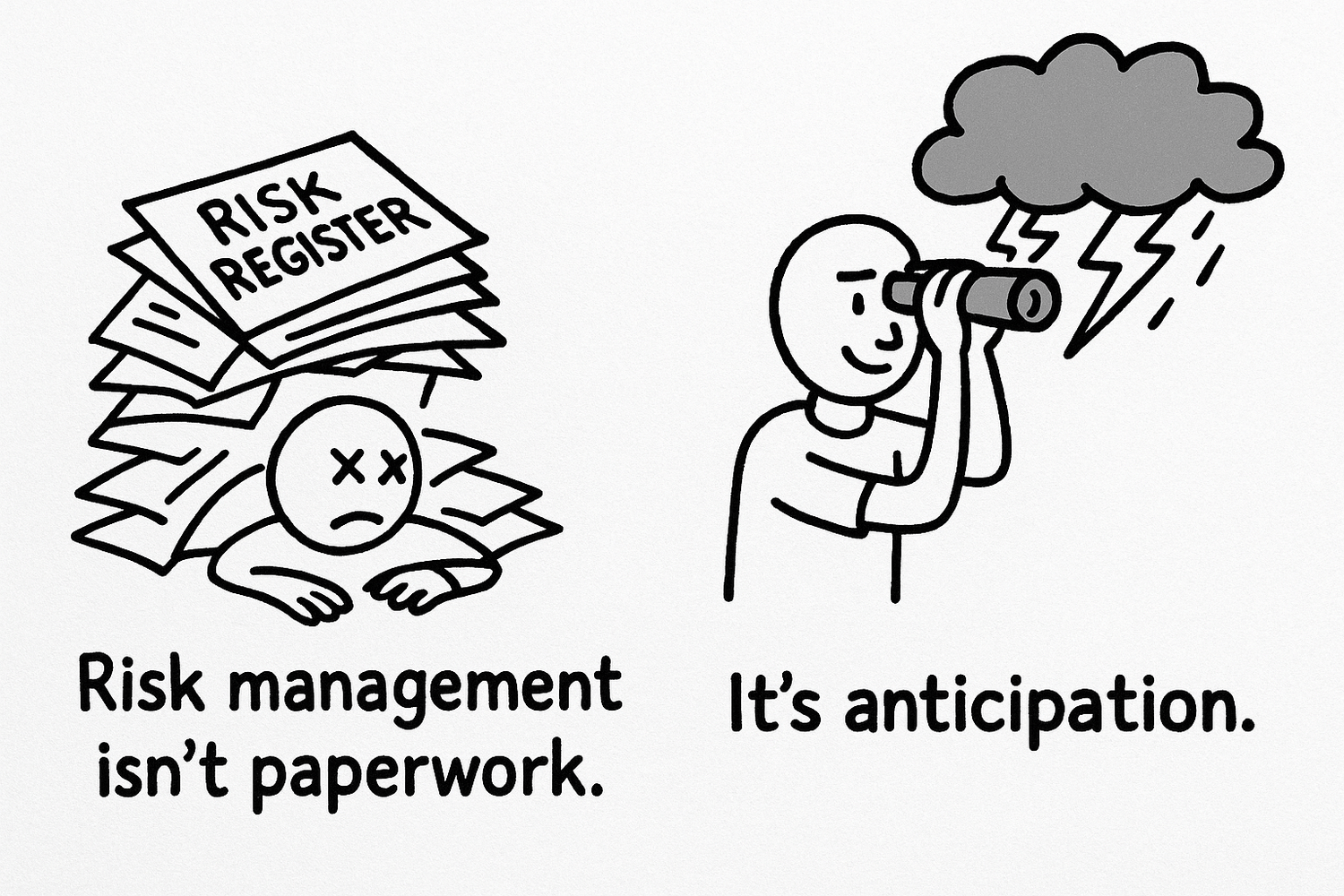
When most people hear the phrase risk management, they picture endless Excel sheets, templates, and forms.
The mental image? A project manager filling out columns, assigning numbers, and filing documents that no one ever looks at again.
But here’s the truth: risk management is not paperwork. It’s leadership.
Risk management doesn’t live in a spreadsheet. It lives in the behaviors, instincts, and decisions of leaders who are willing to think one step ahead.
It’s spotting the silence in a meeting.
Often, the most telling risks aren’t shouted from the rooftops — they’re buried in what people don’t say. A quiet subject matter expert, a hesitant engineer, or a stakeholder who doesn’t want to voice disagreement may be signaling risks you can’t afford to ignore.It’s asking the question nobody wants to ask.
Leaders who practice risk management aren’t afraid of tension. They ask, “What happens if our vendor misses the deadline?” or “What if we lose key staff mid-project?” These aren’t comfortable questions, but they surface the truths that save projects.It’s preparing the backup plan before anyone else thinks of it.
Risk leaders aren’t just documenting scenarios — they’re actively planning mitigations. A contingency plan doesn’t sit in a binder; it’s a living conversation about who will do what when things don’t go as planned.
The spreadsheet is simply the record of anticipation. The real risk management happens before ink hits paper.
Lesson Learned: Risks Aren’t Managed in Excel
Here’s the key takeaway:
👉 Risks aren’t managed in Excel.
👉 They’re managed in conversations and decisions.
The spreadsheet may capture them, but it doesn’t control them. Projects fail not because risks exist — risks are alwayspresent — but because no one saw them coming or no one acted early enough.
A PMI study found that 23% of projects fail due to inadequate risk management PMI, Pulse of the Profession Report, 2021. In other words, risks weren’t the problem. Blindness to them was.
Case Example: NASA and the Challenger Disaster
One of the most infamous failures in risk management is NASA’s Challenger disaster in 1986. Engineers had raised concerns about the O-ring seals in low temperatures, but the silence in the room and the pressure to move forward overrode caution.
The paperwork existed. The data was there.
But risk management failed at the leadership level — in the conversations and decisions that should have stopped the launch.
This illustrates the critical truth: risks don’t kill projects (or missions). Leadership failures around risk do.
What Effective Risk Leadership Looks Like
So what does it mean to practice risk management as leadership, not paperwork?
Facilitate open conversations.
Create psychological safety so team members feel free to raise concerns without fear of judgment or reprisal. Amy Edmondson’s work on psychological safety shows that teams willing to speak up about risks outperform those that stay silent [Edmondson, The Fearless Organization, 2019].Ask the “what if” questions.
Leaders must constantly probe: What if our budget is cut? What if regulations change? What if demand doubles overnight? These questions turn risks into foresight rather than hindsight.Listen to what’s not being said.
Silence, hesitation, or avoidance are red flags. Pay attention to the energy in the room. The loudest voices aren’t always the most important ones.Act early, not late.
Risk management is only useful if it drives timely decisions. Waiting until a crisis hits makes documentation meaningless.Keep risk conversations alive.
Risks evolve as projects evolve. A one-time assessment at kickoff isn’t enough. Risk leadership requires revisiting assumptions continuously.
Why This Matters for Modern Projects
In today’s environment — with global supply chain disruptions, rapidly changing regulations, AI adoption, cybersecurity threats, and economic uncertainty — risk management cannot be treated as a compliance checkbox.
McKinsey reports that companies with mature risk practices recover faster from disruptions and outperform peers in long-term value creation McKinsey, Risk Management in a Volatile World, 2023.
This is leadership in action: anticipation, preparation, and adaptation.
Closing Thought
Paperwork won’t save your project. Leadership will.
Risk management isn’t about filling in forms. It’s about creating a culture where risks are seen, spoken about, and acted upon before they become problems.
The spreadsheet is just the receipt. The real work?
👉 Spotting silence.
👉 Asking the tough questions.
👉 Building backup plans early.
👉 Leading with foresight.
Projects don’t fail because of risks.
They fail because no one saw them coming.
🔗 References:
Project Management Institute (PMI), Pulse of the Profession Report, 2021.
Amy C. Edmondson, The Fearless Organization: Creating Psychological Safety in the Workplace for Learning, Innovation, and Growth, 2019.
McKinsey & Company, Risk Management in a Volatile World, 2023.
Rogers Commission Report, Challenger Disaster Investigation, 1986.
Join our vast online community to learn together and accelerate your success