
Every SAS Program Is a Loop (You Just Didn't Know It)
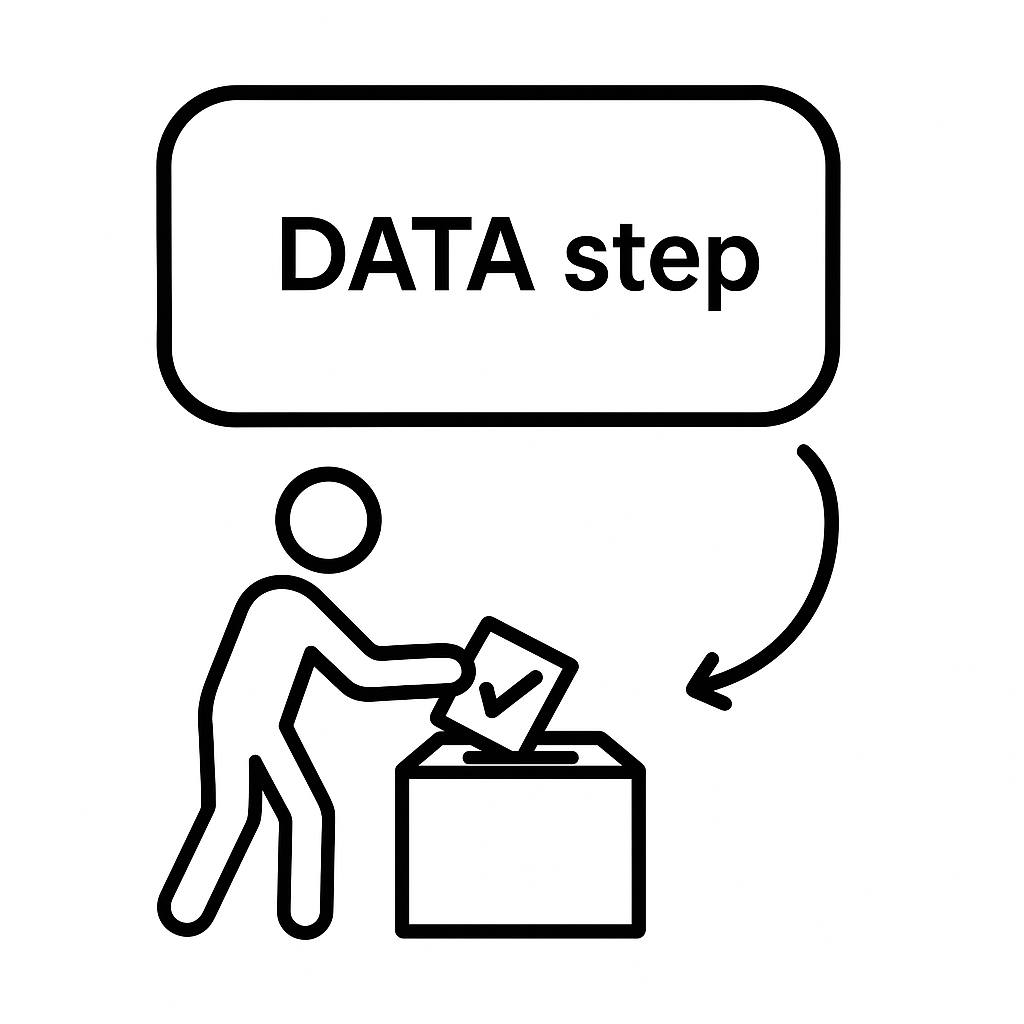
One of the most foundational concepts in SAS programming is the DATA step's "built-in loop," a structure so fundamental that it is rarely stated explicitly. As a result, many users are left to figure it out on their own over time.
The process is a simple but powerful two-part cycle: DATA steps execute both line by line and observation by observation.
First, SAS executes the program statements in the order they are written, from top to bottom. This is the intuitive part.
The more surprising part is that SAS also executes the entire set of statements for one single observation (or row of data) before looping back to the very beginning to process the next observation. In this way, SAS only ever sees one record at a time as it flows through the program. This one-record-at-a-time processing model is incredibly memory-efficient, allowing SAS to process massive datasets that would be too large to fit into a computer's memory all at once.
There is a perfect analogy to make this abstract concept concrete: voting. Voters (the observations) go through the entire voting process (the DATA step) one at a time. Each voter must complete each step in the proper order—giving their name, signing in, casting a ballot—before the next voter can begin. You can't cast your vote before you give your name; everything must be done in the proper sequence for each individual.
Learn more about this concept of Program Data Vector in SAS. Enroll at sas.made2sticklearning.com
Join our vast online community to learn together and accelerate your success